

Table Of Contents
Microsoft has officially introduced Maia 200, its second-generation AI inference chip, marking a major step in the company’s custom silicon strategy. The new processor targets large-scale AI inference workloads inside Azure data centers and aims to deliver higher efficiency, lower costs, and stronger performance for modern AI services.
With AI demand rising across cloud platforms, Microsoft continues to reduce reliance on third-party hardware by building silicon optimized for its own software stack. Maia 200 reflects that push, focusing on inference rather than training, where cost, latency, and power efficiency matter most.
What Maia 200 Is Designed to Do
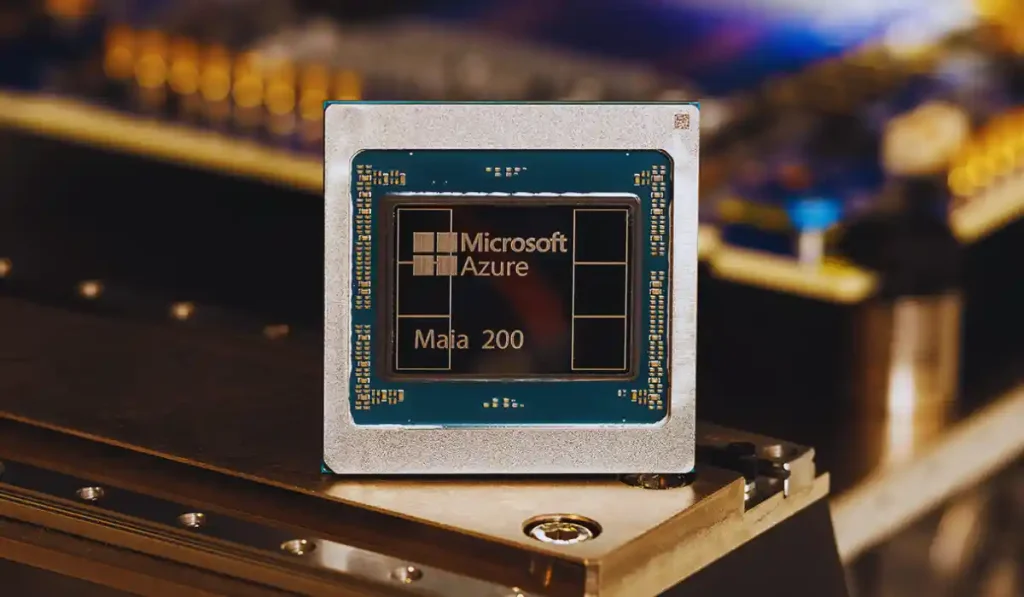
Maia 200 is a purpose-built AI inference accelerator. Microsoft engineered it to run large language models and multimodal AI systems efficiently at scale. Instead of handling model training, the chip focuses on delivering fast responses once models are deployed.
Microsoft designed Maia 200 to support:
- High-volume AI inference workloads
- Large reasoning models used in copilots and assistants
- Multimodal AI tasks involving text, images, and audio
- Cloud-scale deployments inside Azure data centers
This narrow focus allows Maia 200 to optimize every component for inference speed and efficiency.
Key Architecture Highlights
Microsoft built Maia 200 using advanced semiconductor technology and a memory-first design. The architecture prioritizes data movement, which remains a major bottleneck in AI inference.
Core hardware features include:
- Advanced manufacturing process optimized for performance and efficiency
- High-bandwidth memory (HBM) to feed data-hungry AI models
- Large on-chip SRAM to reduce memory access latency
- Specialized engines that accelerate data transfer and token generation
By minimizing memory stalls and maximizing throughput, Maia 200 aims to deliver faster responses at lower power levels.
Performance and Efficiency Gains
Microsoft claims Maia 200 delivers significant improvements over its previous generation and existing Azure hardware. The company highlights gains in both raw performance and cost efficiency.
According to Microsoft, Maia 200 offers:
- Strong gains in low-precision inference, including FP4 and FP8 workloads
- Higher token throughput for large language models
- Improved performance per dollar compared to earlier Azure accelerators
- Better power efficiency for sustained inference workloads
These improvements matter most at scale, where even small efficiency gains can reduce cloud operating costs.
Built for Azure and Microsoft AI Services
Microsoft designed Maia 200 specifically for Azure. The chip integrates tightly with the company’s cloud infrastructure, software stack, and AI services.
Early deployments focus on U.S. Azure regions, with broader availability planned over time. Maia 200 will support internal workloads before expanding to customer-facing services.
Key use cases include:
- Microsoft Copilot experiences across productivity tools
- AI services hosted through Azure AI and Foundry platforms
- Large language model inference for enterprise customers
- Internal AI workloads powering Microsoft services
By controlling both hardware and software, Microsoft can tune performance end to end.
Strategic Importance of Custom Silicon
Maia 200 plays a critical role in Microsoft’s long-term AI strategy. As demand for AI accelerates, cloud providers face rising costs and hardware constraints. Custom chips help Microsoft control supply, pricing, and performance.
The move also positions Microsoft more competitively against other hyperscalers developing in-house accelerators. Instead of relying entirely on external vendors, Microsoft now balances third-party GPUs with its own silicon.
This approach gives Microsoft:
- Greater flexibility in AI infrastructure planning
- Lower dependency on external chip roadmaps
- More predictable performance and cost scaling
- Deeper optimization between hardware and software
Challenges and Real-World Impact
While Maia 200’s specifications look promising, real-world impact will depend on deployment scale and software optimization. Performance claims often reflect peak scenarios rather than sustained workloads.
Microsoft must also ensure developers can easily integrate Maia 200 into existing AI pipelines. Strong tooling, compiler support, and frameworks will determine adoption speed.
Still, Maia 200 signals clear momentum. Microsoft continues to invest heavily in AI infrastructure as competition intensifies.
The Bigger Picture
Maia 200 confirms that AI inference now drives the next phase of cloud innovation. Training models remains important, but inference dominates real-world usage and costs.
By launching its second-generation AI inference chip, Microsoft shows confidence in its silicon roadmap. Maia 200 strengthens Azure’s ability to deliver scalable, cost-effective AI services as demand grows.
As AI workloads expand across industries, custom inference hardware like Maia 200 will play an increasingly central role in cloud computing.
Read More : Ai’s Next Battleground Is Your Body In 2026
